
Framework Design Approach
The EdTech Tulna framework is built on a systematic, research-backed process that combines global evidence with contextual relevance. It draws on international evaluation standards, national educational policies, and direct stakeholder insights to create a robust tool tailored to India’s diverse learning contexts.
The EdTech Tulna framework is informed by:
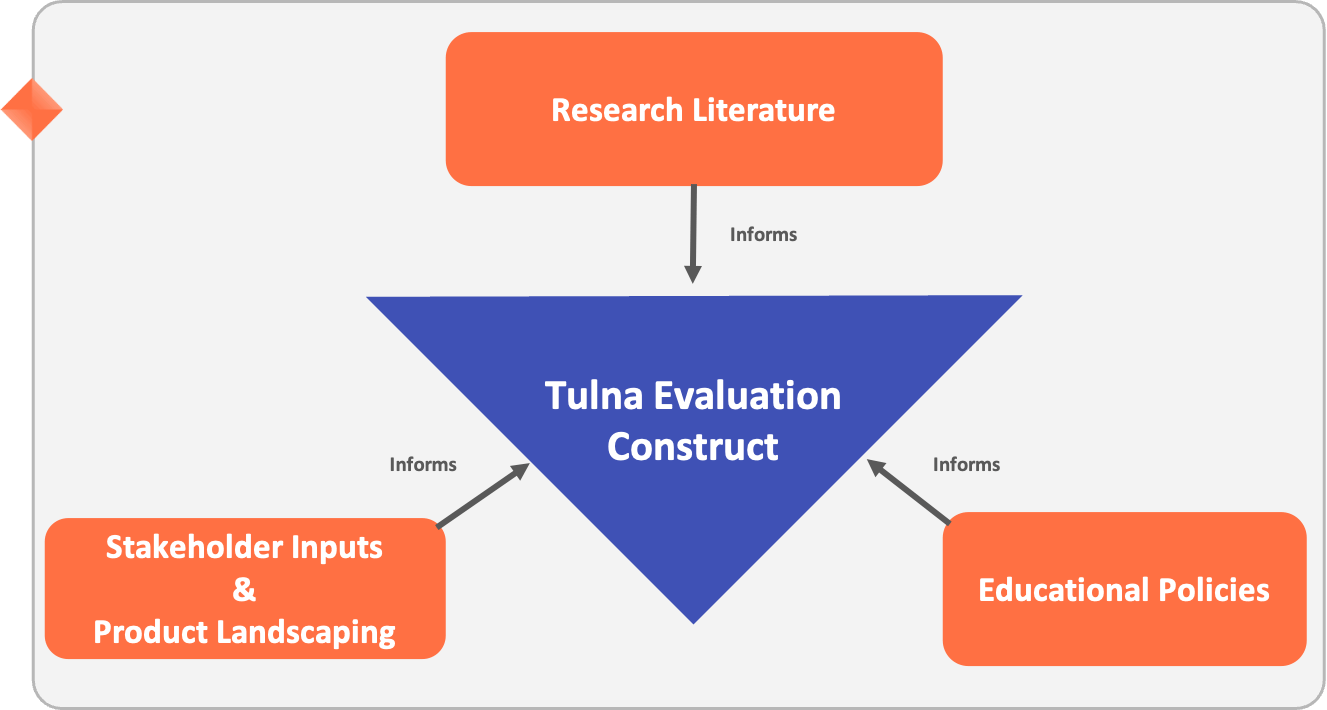

Research Literature

Educational Policies

Stakeholder Interviews and Product Landscaping
The findings and insights from these literature reviews, interviews and landscaping informed the design of the EdTech Tulna tools and framework comprising multiple dimensions, clusters and criteria. This process also revealed how potential users could be supported effectively through these tools and framework.
References
- Mercer, N., & Littleton, K. (2007). Dialogue and the development of children's thinking: A sociocultural approach. Routledge.
- National Curriculum Framework for School Education (2023). National Council of Educational Research and Training, New Delhi, India.
- National Education Policy (2020). Ministry of Human Resource Development, Government of India.
- NITI Aayog. (2018). National strategy for artificial intelligence #AIforAll. Government of India.
- PRAGYATA-Guidelines for Digital Education (2020). Department of School Education & Literacy, Ministry of Human Resource Development, and Government of India.
- Government of India. (2023). The Digital Personal Data Protection Act, 2023. In The Gazette of India.
- Technological Pedagogical Content Knowledge (TPACK): The development and validation of an assessment instrument for preservice teachers (2009). In Journal of Research on Technology in Education (Vol. 42, Issue 2, pp. 123–149).
- Try And Measure Aptitude And Natural Abilities (TAMANNA) (n.d.) Department of School Education and Literacy, Ministry of Human Resource Development, Government of India.
- Vygotsky, L. S. (1978). Mind in society: The development of higher psychological processes. Harvard University Press.